
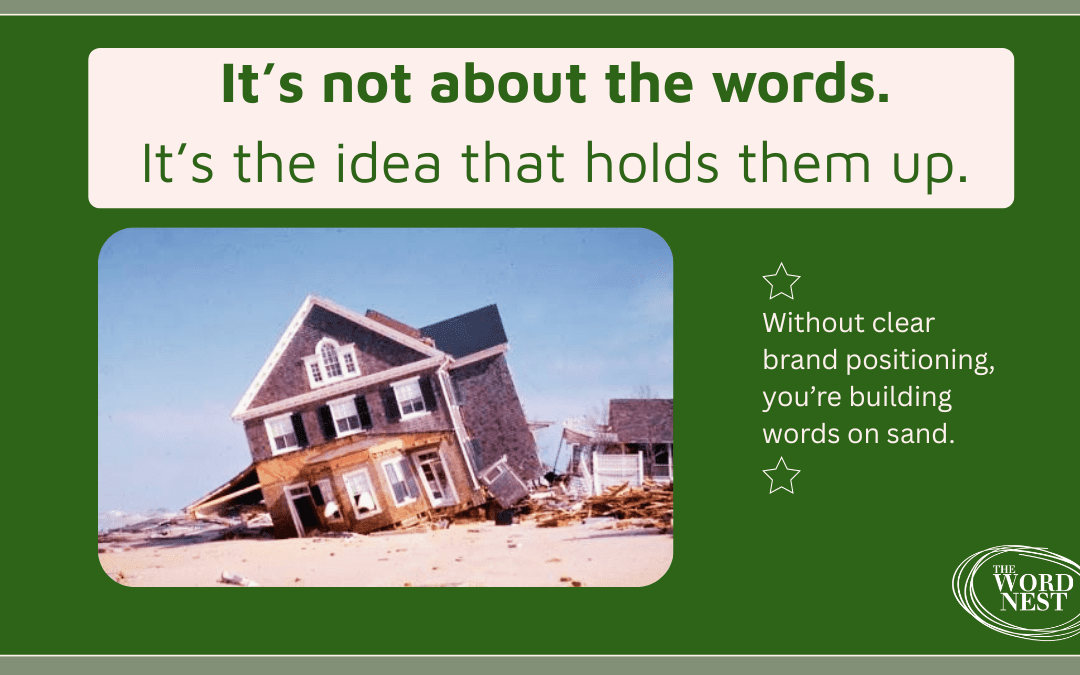
This is something that’s come up repeatedly in client work lately. They’ve freshened up their homepage copy. Or tweaked their About page (again). Maybe they even hired a copywriter. And the words got better, the structure got cleaner, but something still sits a bit… flat.
This is what I usually tell them: That flatness doesn’t live in the sentences. It lives in the layer underneath.
Most of the time, when the words don’t quite land, the issue isn’t the copywriting – it’s a blurry (or non-existant) brand positioning strategy.
The messaging has been built on sand, so no matter how nicely you arrange the words on top, nothing holds its shape.
Brand positioning, the quick version
If you’re short on time, here’s how I explain brand positioning in a nutshell.
Brand positioning is the strategic foundation that defines what your brand stands for, who it’s for, and how it’s meaningfully different in the market.
- Brand positioning is your core point of view
What you believe about your audience, the problem, and your category.
- A strong brand positioning strategy gives your marketing direction
So your messaging isn’t guesswork – it’s grounded in a clear idea.
- Without it, everything sounds the same
Even well-written copy will feel generic if the idea underneath it is vague.
- With it, everything gets sharper
Your website, content, and sales conversations all start pulling in the same direction.
- It usually comes down to one clear idea
Not five values. Not three pillars. One perspective that reframes the problem.
What brand positioning actually is (and why it matters)
Brand positioning gets mistaken for a lot of things. A tagline. A USP. A mission statement…
It’s none of those – though it influences all of them.
Positioning is your brand’s core point of view:
- What you stand for
- Who you’re for
- Where you sit in the market
- And crucially… what you believe that others don’t.
It’s less like a line of copy, and more like a lens.
A way of seeing the problem, the category, and your audience that shapes everything that follows.
Done well, it becomes the thing that guides every decision: what you say, how you say it, what you don’t say – often the most telling part – and where you choose to show up.
The part most brands skip
Positioning doesn’t start with tone of voice. Or messaging pillars. Or a workshop where someone says, ‘we’re all about quality and care’.
(Though it can easily end up there if you’re not careful.)
It starts earlier. And it’s a bit more uncomfortable.
You’re asking:
- What’s really going on for our audience?
- What does our industry tend to get wrong?
- What do we believe should be done differently?
Not surface-level answers. Proper ones.
Because the best positioning usually boils down to one clear idea. Not five values. Not three pillars. One idea.
Something that reframes the problem in a way your audience recognises instantly.
That’s what gives your messaging something to actually say.
And it’s worth knowing: this isn’t a quick workshop exercise. It’s structured thinking – and a bit of uncomfortable honesty – to get to something real.
Why your copy still sounds like everyone else’s
Most brands don’t deliberately skip brand positioning. They just move past it too quickly.
The pattern almost always goes like this:
- ‘We need better messaging.’
- ‘Let’s define our pillars.’
- ‘Why does this still feel generic?’
The pillars become something like: quality, service, results.
(Which is a bit like saying your café serves good food and the staff are friendly.)
True? Probably. Memorable? Not even slightly.
The writing gets the blame when positioning is the actual problem.
What a difference brand positioning makes (a real example)
Let’s take a landscape gardening business as an example.
Skilled team. Beautiful projects. Decent word-of-mouth.
But online? They sound like every other landscaper.
Now, watch what happens when you do this work:
Before positioning work
They describe themselves like this:
‘We create high-quality, tailored outdoor spaces designed to suit your lifestyle.’
Which is technically correct. And completely interchangeable.
Messaging pillars:
- Quality craftsmanship
- Custom designs
- Attention to detail
Every other landscaper in the country could say exactly the same thing. (Most of them do.)
After positioning work
Instead of refining the words, they stepped back and asked what they genuinely believed about their clients and the category.
What came out was this:
‘Most people don’t need a flashier backyard. They need a space they’ll actually use.’
That’s a position.
Messaging pillars:
- Outdoor spaces designed to be lived in, not just looked at.
- Gardens that work on a Tuesday (not just a Saturday arvo).
- Design that fits your habits, not just your block.
These push against the idea that more space, more features, more ‘wow’ equals better. It reframes the problem from size and aesthetics to real-life use. For many homeowners, that lands immediately.
From that clarity, everything sharpens
With well-defined positioning, the same service has a completely different feel.
More specific. More human. More grounded in how people actually live.
The shift didn’t come from better wording. It came from sitting with the business and pulling out the idea they already half-knew – but hadn’t fully articulated yet.
And that’s where the real difference sits
They’re no longer just another ‘high-quality landscaper.’
They’re the team that gets why your outdoor space looked great… and barely got used.
That’s the kind of shift positioning creates.
(It’s the kind of shift we’re aiming for in my brand positioning work.)
Not louder. Just clearer – in a way the right people recognise straight away.
A simpler way to think about it
Brand positioning is the argument your brand makes. Messaging is how you keep making it.
No argument? You get safe, slightly beige language that blends into the background of your category.
Clear positioning, on the other hand, gives every channel of your communication a spine:
- Your website
- Your content
- Your sales conversations
- That About page you’ve rewritten four times
All of it gets sharper.
A few signs your positioning might need work
These tend to show up together:
- Your messaging could belong to any competitor
- Different pages say slightly different things
- You default to the same safe phrases every time
- AI-generated content sounds fine but not like you
Worth saying again: these aren’t writing issues. They’re positioning issues.
This is where AI falls over
AI is brilliant at fluency.
It can produce grammatically spotless, well-structured copy all day long.
What it can’t do is have an original point of view.
AI tools draw on the language patterns of your category, and if your positioning is fuzzy, that’s exactly what comes back at you: the average of everything your competitors have already said.
Give it sharp positioning (a real idea, a clear worldview, something to actually work with) and the whole thing changes. The AI has a specific thread to pull on, and the output starts to sound less like ‘content’ and more like a brand with a voice.
Most AI content problems are really positioning problems in disguise. The prompt isn’t the issue. It’s the thinking that went in before the prompt.
So where do you start?
If you’ve been circling the question of ‘what is brand positioning and how do we actually define it’, this is where it becomes practical.
Not with a 40-page document. Not with a rebrand.
Start here:
What do we believe about this problem that others in our space are glossing over?
Once you’ve got a real answer, test it:
- Does it explain the problem more clearly than the standard industry line?
- Does it push back (even gently) on a common assumption?
- Does it actually change the way we talk to our audience about what we do?
If yes, you’ve got the seed of something worth building on.
From there, your messaging pillars aren’t a creative exercise. They’re a translation job: taking that core idea and finding the everyday language that makes it repeatable across your website, your content, your sales conversations.
Not separate from the positioning. Grown from it.
Where this fits in
This is the work I do before any copy gets written.
(You can see how I approach it here.)
A focused piece of thinking that gets to the core idea your brand is built on – so everything that follows has direction, and your website, content and sales conversations stop pulling in different directions.
With clients, this usually means:
- Pressure-testing what you think your positioning is
- Looking at your category properly (not just a quick competitor skim)
- Finding the gap between what everyone’s saying and what actually matters to your audience
- Distilling that into a clear, usable idea your whole team can work from
From there, messaging becomes much easier. Because we’re not trying to sound better. We’re saying something more precise.
The bit I’ll leave you with
If your brand feels flat, vague, or slightly off, resist the urge to rewrite everything.
Pause.
Go back a layer.
Find your positioning idea first.
Because once you’ve got that, the writing stops being the hard part. It just becomes the way you express something that’s already clear.
If you’re in that ‘something’s not quite landing’ stage, you’re probably not a writing tweak away from fixing it. You need the layer underneath. If you want clarity on what that layer looks like for your brand, I can help you find it – and what to do with it next. Start here.